The Waking: Theodore Roethke
I wake to sleep, and take my waking slow.
I feel my fate in what I cannot fear.
I learn by going where I have to go.
We think by feeling. What is there to know?
I hear my being dance from ear to ear.
I wake to sleep, and take my waking slow.
Of those so close beside me, which are you?
G_d bless the Ground! I shall walk softly there,
And learn by going where I have to go.
Light takes the Tree; but who can tell us how?
The lowly worm climbs up a winding stair;
I wake to sleep, and take my waking slow.
Great Nature has another thing to do
To you and me, so take the lively air,
And, lovely, learn by going where to go.
This shaking keeps me steady. I should know.
What falls away is always. And is near.
I wake to sleep, and take my waking slow.
I learn by going where I have to go.
Sunday, 12 December 2010


Thursday, 9 December 2010
Alexander Woollcott

Wednesday, 8 December 2010
"Reading Proust is like bathing in someone else's dirty water."-Alexander Woollcott
"His father died in 1903 and his mother in 1905. After the deaths of his parents he increasingly withdrew from social life and he became a virtual recluse, spending most of his time in bed writing, in a room lined with cork to exclude noise, with all the windows shut and the air thick with inhalents. His friends were usually summoned to visit him at night. After 1907 he lived mainly in a cork-lined room in his apartment on the Boulevard Haussmann, writing mostly at night. His last public appearance was at the New Year's Eve ball given by the discreetly homosexual Comte de Beaumont in 1921."
Proust's multifaceted vision is enthralling. He was a satirist and a nanoscopic analyst of introspective consciousness, a chronicler and theorist of Eros, exploring nuances of human sexuality, a wise and ethical writer. He was the creator of more than forty unforgettable characters who continue to resonate in the world's literary consciousness. Above all, Proust's central message is the affirmation of life. Contrary to the opinion voiced by some of his contemporaries and critics, Proust's great work teaches that life's "purpose" is not to be sought in artistic artefacts: life is not fulfilled when a painting or a novel is completed, but when it is transmuted, in the very course of quotidian living, into something "artistic" or spiritually mature and wise.
"Reading Proust is like bathing in someone else's dirty water."-Alexander Woollcott
When I was around 6 I was sent to a boarding school in East Sussex and I was one of three small girls. The rest were boys. Bath time happened once a week on a Saturday.
We were all lined up naked from the bathroom, on the landing and down the first and second flight of stairs. There must have been 50 of us, maybe less. In any case we were lined up alphabetically, each week the same order. Because of my surname starting with a P I was way down the queue.
The bathtub was filled half-way with water and every child was bathed in the same water in the same tub three at a time! Three at a time! Scrub scrub scrub. The matron would use the same flannel and wipe our faces and ears, ask us to soap ourselves and then rinse us with a beaker of water which by this time pretty cold water!
By the time I climbed in with two boys on either side the water was quite dirty and cool! Memorable colour and memorable water!
I was next to a kid who used to gross me out, poor thing! He would spit when he talked and had a gravelly voice. He wanted to trade all the time. Sweets for treats! He would get a great tuck box every term filled with Mars bars and such.
Is this my Madeleine experience? What is the trigger? Dishwater?
Proust's multifaceted vision is enthralling. He was a satirist and a nanoscopic analyst of introspective consciousness, a chronicler and theorist of Eros, exploring nuances of human sexuality, a wise and ethical writer. He was the creator of more than forty unforgettable characters who continue to resonate in the world's literary consciousness. Above all, Proust's central message is the affirmation of life. Contrary to the opinion voiced by some of his contemporaries and critics, Proust's great work teaches that life's "purpose" is not to be sought in artistic artefacts: life is not fulfilled when a painting or a novel is completed, but when it is transmuted, in the very course of quotidian living, into something "artistic" or spiritually mature and wise.
"Reading Proust is like bathing in someone else's dirty water."-Alexander Woollcott
When I was around 6 I was sent to a boarding school in East Sussex and I was one of three small girls. The rest were boys. Bath time happened once a week on a Saturday.
We were all lined up naked from the bathroom, on the landing and down the first and second flight of stairs. There must have been 50 of us, maybe less. In any case we were lined up alphabetically, each week the same order. Because of my surname starting with a P I was way down the queue.
The bathtub was filled half-way with water and every child was bathed in the same water in the same tub three at a time! Three at a time! Scrub scrub scrub. The matron would use the same flannel and wipe our faces and ears, ask us to soap ourselves and then rinse us with a beaker of water which by this time pretty cold water!
By the time I climbed in with two boys on either side the water was quite dirty and cool! Memorable colour and memorable water!
I was next to a kid who used to gross me out, poor thing! He would spit when he talked and had a gravelly voice. He wanted to trade all the time. Sweets for treats! He would get a great tuck box every term filled with Mars bars and such.
Is this my Madeleine experience? What is the trigger? Dishwater?
Monday, 6 December 2010
Frozen Image
Ever since I was a young girl and heard about Proust and his magnum opus I imagined, the image which has stuck in my mind, is of a naked Proust sitting in his copper bathtub surrounded by cork walls and gazing into his navel which has liquid bath water in it.
This image still haunts me whenever I even say his name.
(perhaps the title should be Wet Image for this post)
This image still haunts me whenever I even say his name.
(perhaps the title should be Wet Image for this post)
Sunday, 5 December 2010
The End of Boys
Peter Hoffmeister was a nervous child who ran away repeatedly and bit his fingernails until they bled. Home-schooled until the age of fourteen, he had only to deal with his parents and siblings on a daily basis, yet even that sometimes proved too much for him. Over the years, he watched his mother disintegrate into her own form of mania, while his father—a scholar and doctor who had once played semi-pro baseball—was strict and pushed Peter particularly hard. He wanted only the best from his son but in the process taught Peter to expect only the worst from himself. In the midst of his chaotic home life, Peter began to hear a voice—an insistent, monotone that would periodically dictate his actions. When Peter finally entered public school he started to break free from his father’s control—only to fall sway to the voice more and more. His obsessive-compulsive behavior morphed into ruthless competition in sports and, ultimately, into lies, violence, and drugs. Deceit and brutality became his sole currency as he was tossed from institution to institution, with his younger brother Cooper as his only ally—a boy as lost as Peter.
The End of Boys is one man's journey to the very brink of sanity and back, a harrowing and heartbreaking account of the trauma of adolescence and the redemption available to us all, if only we choose to find it.
This sounds like a worthwhile book to read, it is available for pre-order right now.
The End of Boys is one man's journey to the very brink of sanity and back, a harrowing and heartbreaking account of the trauma of adolescence and the redemption available to us all, if only we choose to find it.
This sounds like a worthwhile book to read, it is available for pre-order right now.
Mirror mirror on the wall
Narcissism: The Malady of Me
No one has yet devised the perfect questionnaire to diagnose what’s commonly known as narcissism. But it hardly matters. Most people can smell it from across the company cafeteria, and in the most precious precincts of places like New York, Los Angeles and London, it’s a familiar scent.
No one has yet devised the perfect questionnaire to diagnose what’s commonly known as narcissism. But it hardly matters. Most people can smell it from across the company cafeteria, and in the most precious precincts of places like New York, Los Angeles and London, it’s a familiar scent.
This is why an escalating debate among psychiatrists about whether to drop narcissistic personality disorder from the field’s diagnostic manual is such a juicy one. For amateur psychiatrists (everyone over the age of 7), the argument strikingly illustrates the ways in which science informs language, and popular culture in turn broadens and enriches scientific ideas, sometimes altering the professional debate.
In recent months, experts working to update the American Psychiatric Association’sinfluential Diagnostic and Statistical Manual of Mental Disorders have been discussing whether to introduce a new approach to diagnosing the so-called personality disorders.
In psychiatry, this is a serious business. These disorders are severely disabling, and the new approach proposes to phase out five of the disorders — dependent, histrionic, schizoid and paranoid, in addition to narcissistic, the least common — in favor of choosing from a list of personality traits that best describe a particular patient.
All five disorders have taken on a life of their own among therapists as well as researchers. As with everything DSM, as the manual is known, the experts will be debating the new approach for years after the psychiatric association’s task force releases the final draft, expected in 2013.
Nonscientists have been appropriating technical terms going back at least to the ancient Greeks and their doctors’ notion of the humors. In more recent generations, people have borrowed freely from physics (black hole, light speed), geology (tectonic shift), cardiology (type A personality) and most of all psychology.
Freudian terminology spread like pollen in the first half of the 20th century, especially in postwar America, transforming precise concepts like ego, repression and projection into widely understood shorthand for behavior. Therapists in turn have reclaimed and reinterpreted these and other Freudian ideas as they refine their own work.
“This process goes on in all sciences, where terms with narrow, technical definitions move into general use and acquire much broader meanings,” said James G. Ennis, a sociologist at Tufts University. “But especially so in the social sciences, which hit people closer to where they live. Psychology, sociology, anthropology — all are essentially providing people with a way of understanding their identities.”
The modern DSM, more so than any other medical document, stirs this crossbreeding, because it tries to draw a line between normal and abnormal behavior. For years people used the term “schizophrenic” to mean split-minded, or scattered, despite the severity of the diagnosis. The DSM committee dropped so-called passive-aggressive personality from the manual years ago, but the phrase is such an evocative description of a familiar behavior that it has become a fixture of the shared language. Terms like O.C.D. andA.D.H.D. are quickly gaining a similar status.
Narcissism was always a natural. Its technical definition describes a devastatingly vulnerable person, compensating for a deeply imprinted inadequacy with a desperate need for admiration, and a grandiose self-image. “When you see extreme examples of this or other personality disorders, you sit back and say: ‘Wow. It’s just stunning,’ ” said Dr. Darrel Regier, research director at the psychiatric association and co-director of the team updating the DSM. “But all of these disorders are on a continuum with more normal behavior, and people will immediately pick up on some of more annoying traits in the definition and run with it.”
And why not? Virtually all of the narcissistic types most people see are the milder, more normal variety, and the idea that these pompous clowns are crying on the inside doesn’t excuse how they treat others. No blaming it on Mom or Dad or some nanny.
“There’s a lot of self-centeredness in the world, and narcissist has become an instantly recognizable type,” even if people don’t appreciate the complexity of the diagnosis, said Dr. Andrew E. Skodol II, chairman of the DSM personality disorders work group and research professor of psychiatry at the University of Arizona College of Medicine.
Stripped of most — but not quite all — of its pathology, “narcissist” becomes an easy way to flag the self-smitten (if not used as an all-purpose insult), and sounds so much more thoughtful than “egomaniac,” the older term, invoking Greek myth and modern psychiatry. “It’s a shorthand you can apply to all these powerful and famous people that allows you to feel superior and have this gloss of science,” said Dr. Michael First, a psychiatrist at Columbia and a former editor of the DSM.
A word like that is not going anywhere, regardless of what the experts working on the DSM decide. On the contrary: in recent months some of the researchers pushing to drop the diagnosis have softened their stance; the betting now is that the diagnosis is going to remain in the final revision.
The term, like so many people it describes in life and in treatment, cannot be so easily ignored.
Benedict Carey in The New York Times Dec 4 2010
Benedict Carey in The New York Times Dec 4 2010
My simple body
Head
Neck
Shoulders
Chest
Torso
Waist
Navel
Hips
Bodily/biological function area
Thighs
Knees
Calves
Ankles
Feet
Neck
Shoulders
Chest
Torso
Waist
Navel
Hips
Bodily/biological function area
Thighs
Knees
Calves
Ankles
Feet
Friday, 3 December 2010
My simple head
Using less than 25% of my capacity to think, process, imagine, wonder, invent etc.
I am bored.
Stuck inside this cottage surrounded by snow and icicles, I and can't even see the sheep for all the white!
I never used to be bored.
I am boring.
Now I am going up the walls with feeling trapped.
The cats, the boys anyway, roll around wrestling...fur flying!
Who am I to wrestle with? My simple head?
I want to read, can't. I want to write, can't.
Thinking is out of the question.
I can make lunch. Yes, that'll do for now.
I am bored.
Stuck inside this cottage surrounded by snow and icicles, I and can't even see the sheep for all the white!
I never used to be bored.
I am boring.
Now I am going up the walls with feeling trapped.
The cats, the boys anyway, roll around wrestling...fur flying!
Who am I to wrestle with? My simple head?
I want to read, can't. I want to write, can't.
Thinking is out of the question.
I can make lunch. Yes, that'll do for now.
Thursday, 2 December 2010
My simple heart
Navel gazing for today includes, by being trapped indoors for a week now and not going fully stir crazy, has a lot to do with The Belly Button keeping me busy.
Napping with Fergus who likes to get under the duvet with me and nap!
Giving Myles a tiny saucer of milk at tea time.
And Luna, yes Luna she insists on sleeping on top of me most of the night. Makes it a little tricky to turn without upsetting her.
So the three cats are much observed and enjoyed.
We made small paths for them around the yarden so they could get out and about and do their business. They seemed to find it much fun running in their very own bobsled tracks.
Myles tried licking the snow. No likey.
However in all fairness it is the cats who keep me sane or insane whatever fits best.
Napping with Fergus who likes to get under the duvet with me and nap!
Giving Myles a tiny saucer of milk at tea time.
And Luna, yes Luna she insists on sleeping on top of me most of the night. Makes it a little tricky to turn without upsetting her.
So the three cats are much observed and enjoyed.
We made small paths for them around the yarden so they could get out and about and do their business. They seemed to find it much fun running in their very own bobsled tracks.
Myles tried licking the snow. No likey.
However in all fairness it is the cats who keep me sane or insane whatever fits best.
Flaubert's Parrot


Party games
The "questionnaire" seems like an odd sort of party game. You probably have to sit down somewhere and write down the answers and then it gets read out aloud to all party-ers. If you know it is going to be read out that would affect what you write would it not? On the other hand it probably also would make you want to write something amusing and clever as well.
That sort of game would not work well for me. Either I would take it far too seriously, or in fact what is more likely I would not know the answers to any of the questions.
I like jigsaw puzzles. Doing crosswords. Playing solitaire with paper cards.
Most of all I like drinking tea!
I like being cosy and reading a book or an interesting article from a paper or periodical. Looking at the cats and enjoying their presence in a variety of ways. I also like looking out of he window at the various views.
It sounds pretty sedentary does it not? Well it is. We are snowed in since last week and I mean snowed in.
That sort of game would not work well for me. Either I would take it far too seriously, or in fact what is more likely I would not know the answers to any of the questions.
I like jigsaw puzzles. Doing crosswords. Playing solitaire with paper cards.
Most of all I like drinking tea!
I like being cosy and reading a book or an interesting article from a paper or periodical. Looking at the cats and enjoying their presence in a variety of ways. I also like looking out of he window at the various views.
It sounds pretty sedentary does it not? Well it is. We are snowed in since last week and I mean snowed in.
Wednesday, 1 December 2010
The party game at the time of Proust's youth
Questionnaire Proust filled out at age 13:
- What do you regard as the lowest depth of misery?
- Proust: To be separated from Mama Your answer:
- Where would you like to live?
- Proust: In the country of the Ideal, or, rather, of my ideal Your answer:
- What is your idea of earthly happiness?
- Proust: To live in contact with those I love, with the beauties of nature, with a quantity of books and music, and to have, within easy distance, a French theater Your answer:
- To what faults do you feel most indulgent?
- Proust: To a life deprived of the works of genius Your answer:
- Who are your favorite heroes of fiction?
- Proust: Those of romance and poetry, those who are the expression of an ideal rather than an imitation of the real Your answer:
- Who are your favorite characters in history?
- Proust: A mixture of Socrates, Pericles, Mahomet, Pliny the Younger and Augustin Thierry Your answer:
- Who are your favorite heroines in real life?
- Proust: A woman of genius leading an ordinary life Your answer:
- Who are your favorite heroines of fiction?
- Proust: Those who are more than women without ceasing to be womanly; everything that is tender, poetic, pure and in every way beautiful Your answer:
- Your favorite painter?
- Proust: Meissonier Your answer:
- Your favorite musician?
- Proust: Mozart Your answer:
- The quality you most admire in a man?
- Proust: Intelligence, moral sense Your answer:
- The quality you most admire in a woman?
- Proust: Gentleness, naturalness, intelligence Your answer:
- Your favorite virtue?
- Proust: All virtues that are not limited to a sect: the universal virtues Your answer:
- Your favorite occupation?
- Proust: Reading, dreaming, and writing verse Your answer:
- Who would you have liked to be?
- Proust: Since the question does not arise, I prefer not to answer it. All the same, I should very much have liked to be Pliny the Younger. Your answer:
Questionnaire Proust filled out at age 20:
Questions which are identical or nearly identical to questions from the previous questionnaire were omitted.- Your most marked characteristic?
- Proust: A craving to be loved, or, to be more precise, to be caressed and spoiled rather than to be admired Your answer:
- What do you most value in your friends?
- Proust: Tenderness - provided they possess a physical charm which makes their tenderness worth having Your answer:
- What is your principle defect?
- Proust: Lack of understanding; weakness of will Your answer:
- What to your mind would be the greatest of misfortunes?
- Proust: Never to have known my mother or my grandmother Your answer:
- What would you like to be?
- Proust: Myself - as those whom I admire would like me to be Your answer:
- What is your favorite color?
- Proust: Beauty lies not in colors but in their harmony Your answer:
- What is your favorite flower?
- Proust: Hers - but apart from that, all Your answer:
- What is your favorite bird?
- Proust: The swallow Your answer:
- Who are your favorite prose writers?
- Proust: At the moment, Anatole France and Pierre Loti Your answer:
- Who are your favorite poets?
- Proust: Baudelaire and Alfred de Vigny Your answer:
- Who are your heroes in real life?
- Proust: Monsieur Darlu, Monsieur Boutroux (professors) Your answer:
- Who are your favorite heroines of history?
- Proust: Cleopatra Your answer:
- What are your favorite names?
- Proust: I only have one at a time Your answer:
- What is it you most dislike?
- Proust: My own worst qualities Your answer:
- What historical figures do you most despise?
- Proust: I am not sufficiently educated to say Your answer:
- What event in military history do you most admire?
- Proust: My own enlistment as a volunteer! Your answer:
- What natural gift would you most like to possess?
- Proust: Will power and irresistible charm Your answer:
- How would you like to die?
- Proust: A better man than I am, and much beloved Your answer:
- What is your present state of mind?
- Proust: Annoyance at having to think about myself in order to answer these questions Your answer:
- What is your motto?
- Proust: I prefer not to say, for fear it might bring me bad luck.
Your answer:
- This Proust's Questionnaire, slightly altered, is often found in popular periodicals such as Vanity Fair and the Guardian weekend magazine.
More much more on the overcoat...
In Search of Proust’s Overcoat
August 30, 2010 | by Stephanie LaCava
 Proust’s Overcoat tells the story of Jacques Guérin, a Parisian perfume magnate, who was obsessed with the works of Marcel Proust. In 1929, through a chance connection, he met Proust's family, only to discover that they intended to destroy the author's notebooks, letters, and manuscripts. Guérin ingratiated himself with Proust's heirs, and through bribery and kindness, amassed a collection of Proust's belongings and manuscripts, saving it from destruction. I recently exchanged e-mails with Lorenza Foschini, an Italian journalist, about her book.
Why was Proust’s overcoat so special?
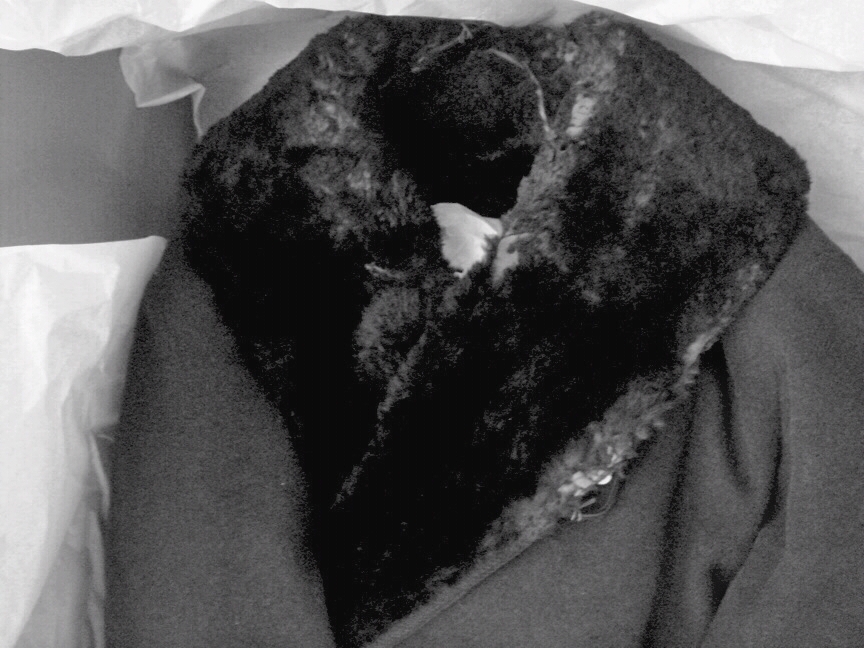
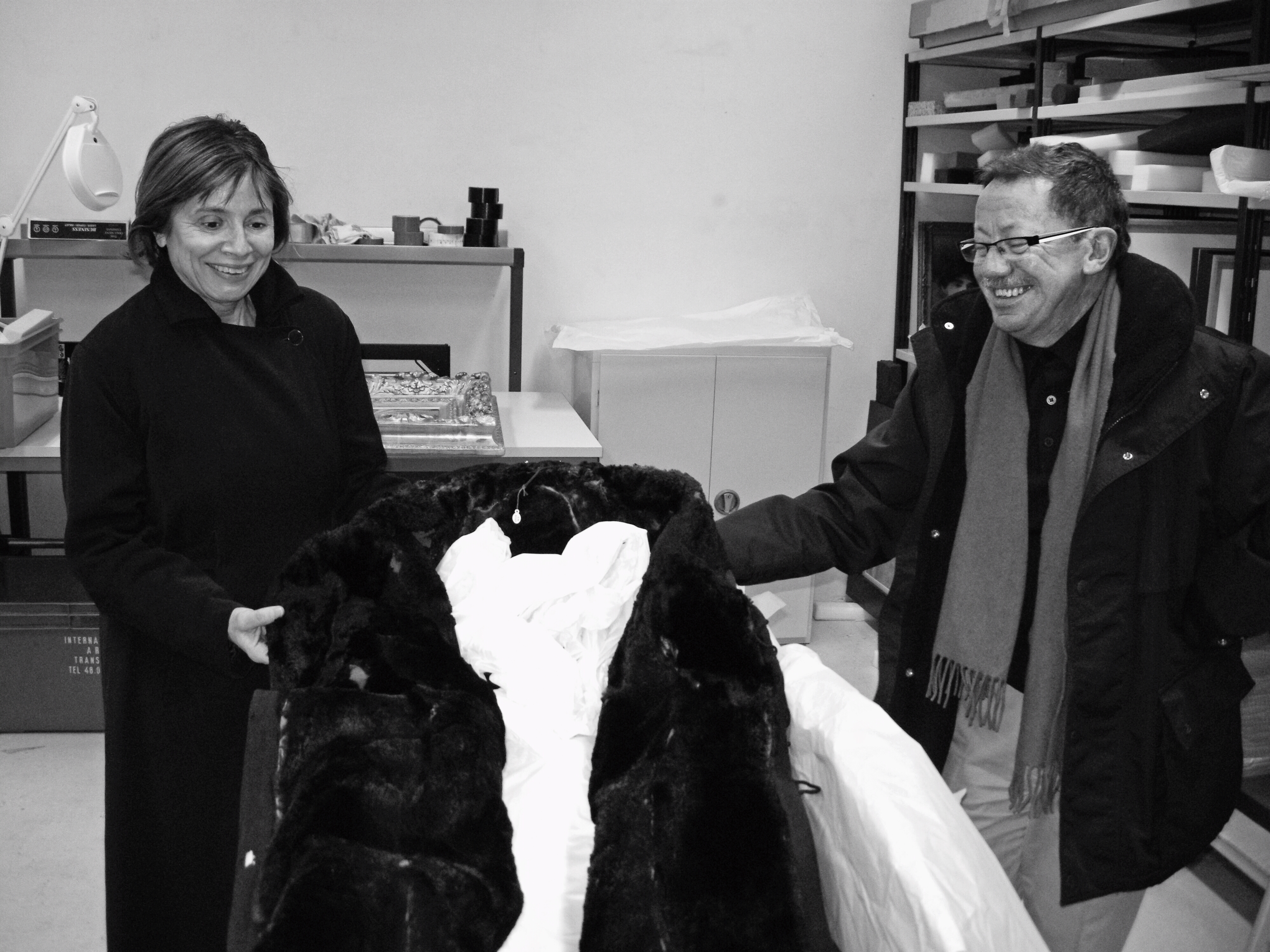
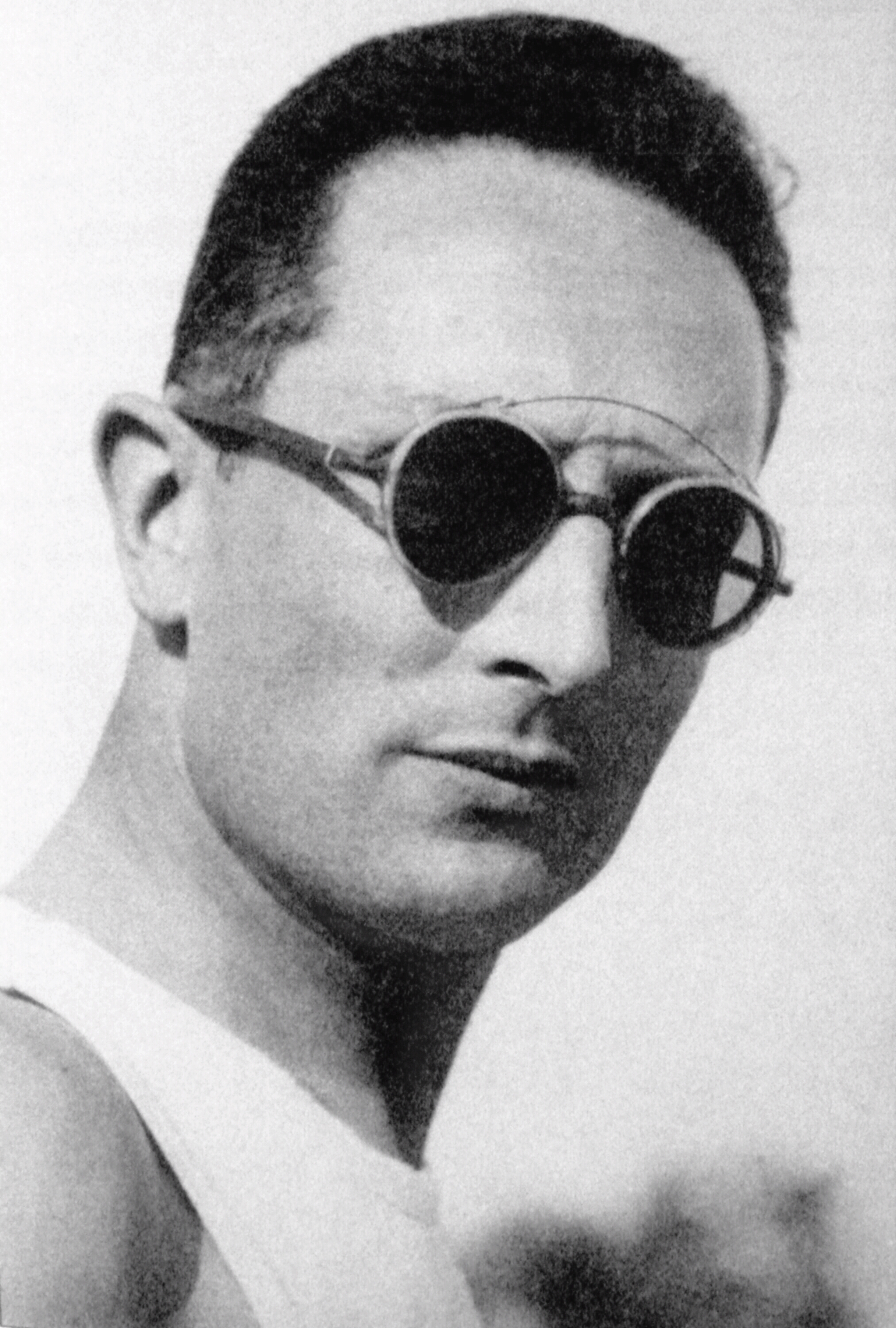
Proust's contemporaries, like Jean Cocteau, described his style as embodying an old, refined elegance. He was a real dandy, always dressed in large silk shirtfronts by Charvet, a double-breasted waistcoat, very light colored gloves with black points, a flat-brimmed top hat, a rose or an orchid in a buttonhole of his frock coat, and a walking cane. But even on the hottest days, Marcel didn’t remove his heavy fur-lined coat. This became legendary among those who knew him.
How did you discover this story?
Those who love Proust know that such passion often becomes a mania. This was so in my case. When interviewing the well-known Visconti costume designer, Piero Tosi, I could not resist the temptation to ask him if he knew the reason why the great filmmaker (Luchino Visconti) stopped production on his beloved project, bringing In Search of Lost Time to the big screen.
In the early seventies, the American studios allocated a lot of money for this project and there was talk of casting actors like Laurence Olivier, Marlon Brando, Dustin Hoffman, even Greta Garbo. Tosi was invited to Paris to go over production plans. It was there that he met a very special person. My book comes from the extraordinary story that Tosi told me about this man, Jacques Guérin.
I can understand the need to collect the letters, diaries, and notes of a writer. But can you explain our obsessions with a writer's personal objects? Why a bed? A rug? A coat?
It's because of Guérin that a draft of Swann's Way became available to us. The same goes for several versions of the last volume of In Search of Lost Time.
My book is a story about the incredible efforts of a great bibliophile. Guérin was able to save important papers that offended the bourgeois respectability of Proust’s prude sister in law. After Proust’s death, his family began to deliberately destroy and sell his notebooks, letter, manuscripts, furniture, and personal effects.
Proust's homosexuality surrounded him like an invisible and insurmountable wall. His family's unwillingness to understand this led to a history of silence that mutated into rancor. This transformed into acts of vandalism as his papers were destroyed and his furniture abandoned. Finding the coat is only the conclusion of a series of adventures and coup de théâtre that Guérin had to face. I do not want to reveal them now; you have to read the book.
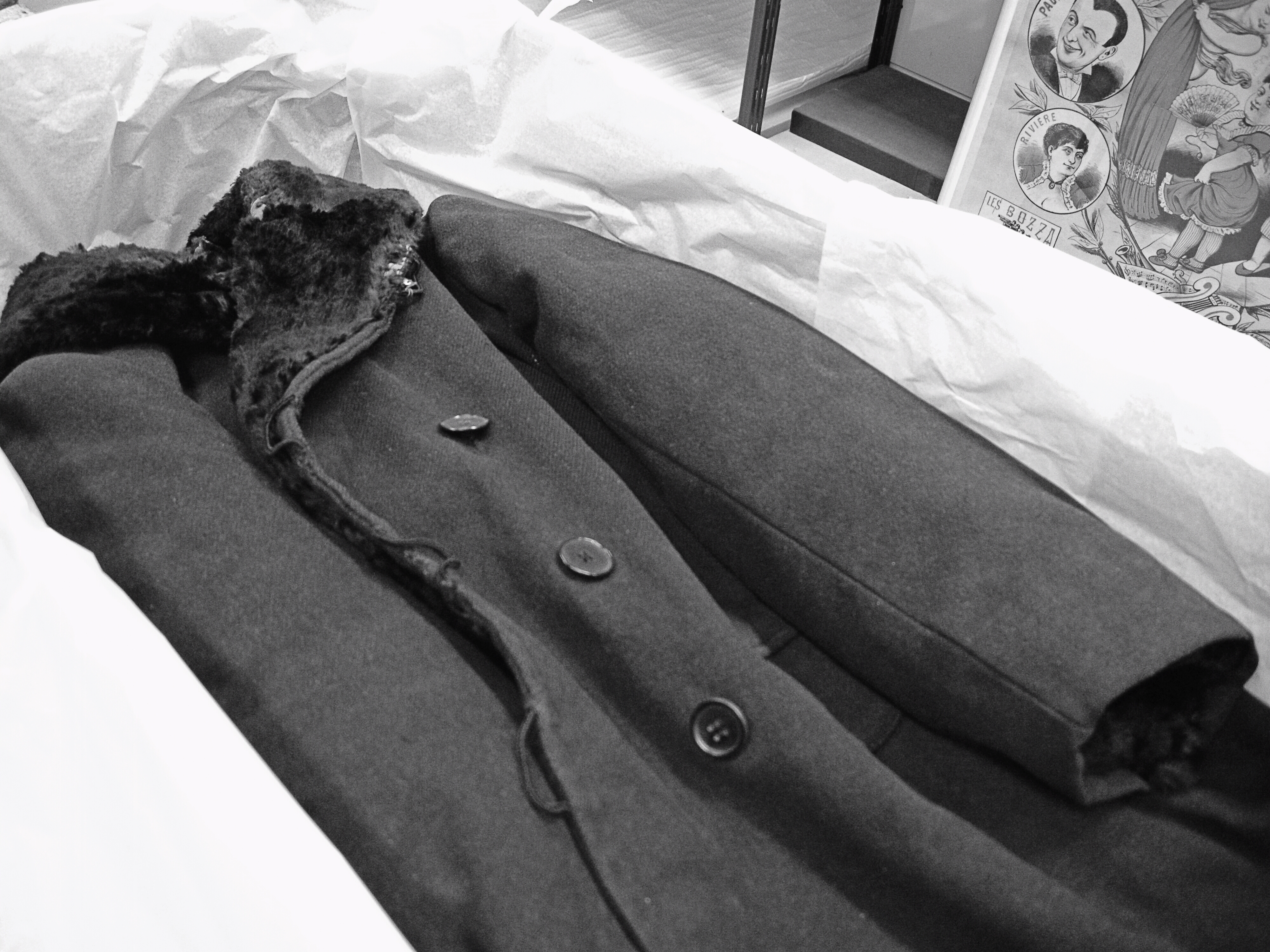
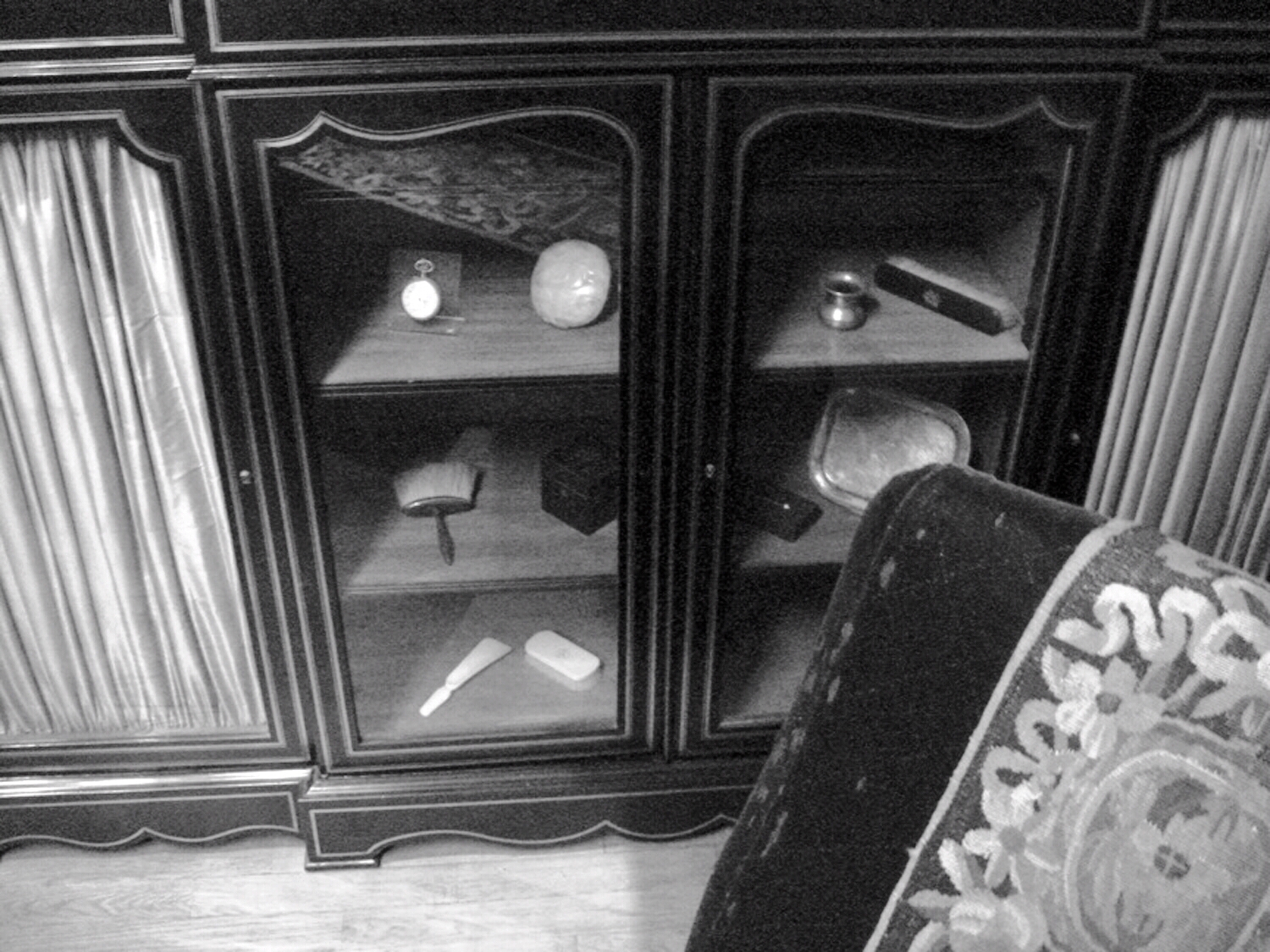
Of all of Proust's objects collected by Guérin, which is your favorite?
If I were to answer, it would diminish the simple fetishism of Guérin's love for the objects, which he saved from flames. Proust writes in Swann's Way: “The Celtic belief that the souls of those we have lost are held captive in some lesser being, in an animal, a vegetable, an inanimate object, in effect lost to us until the day, which for some of us never comes, when we find ourselves walking near a tree and it dawns on us this object in their prison. The souls shudder, they call out to us and as soon as we have heard them, the spell is broken. Liberated by us, they triumph over death and come to live among us once again.” Guérin, for sure, had to know this.
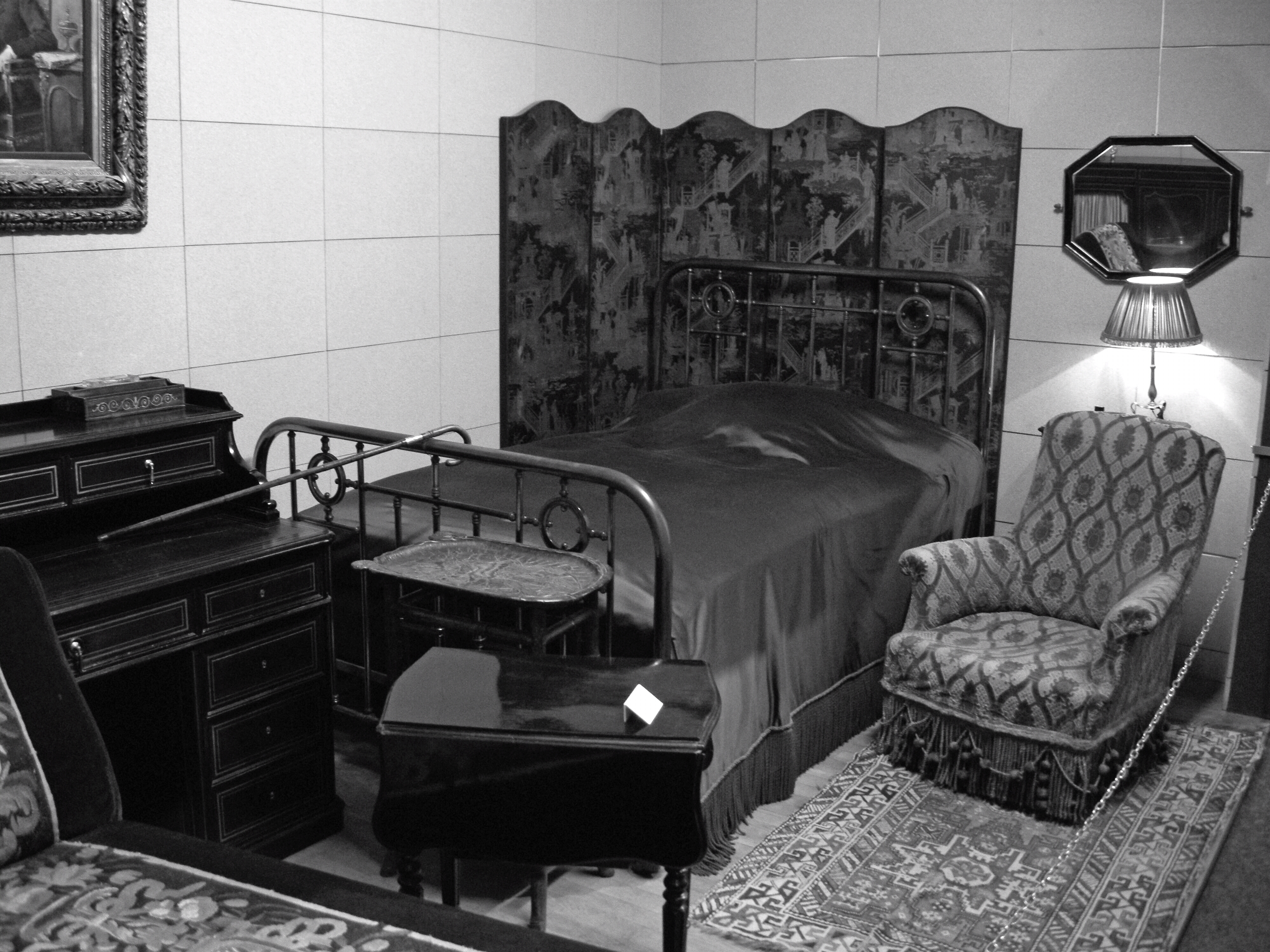
I do love the bed that Proust had since he was sixteen, where he wrote his entire opus, and where he died on November 18, 1922. For Walter Benjamin, there were only two moments in history chronicling the rigging of such “scaffolding.” The first was when Michelangelo, lying prone, his head thrown back, painted the creation of the world on the Sistine Chapel’s ceiling; the second was the “bed on which the ailing Proust lay, pen in his raised hand, covering innumerable pages in writing consecrated to the creation of his own microcosmic world.”
What drives a collector like Guérin?
Jacque Guérin loved to define himself (despite having one of the greatest book collections in the world) not as a collector, but as a rescuer. He would say that his passion was to save rare books, manuscripts and photos from destruction and negligence.
When did your own fascination with Proust begin?
I was eighteen and I was in Naples where I was born (at that time, I was living in Rome with my parents). I was a guest of the man who would become the father of my daughter, Camilla. I couldn't sleep and found near the bed a Livre de Poche of Proust. I didn't sleep the entire night. I never left the book, and took the last volume with me on my honeymoon.
Madeleines


Beautiful shape, an oblong shell, looks like it could house a Virgin Mary or a Venus.
A delectable treat which goes equally well with a cup of tea as a cup of hot cocoa/chocolate.

Proust's Overcoat by Lorenza Foschini
Marcel Proust worked at night. Tormented by illness, he would retire to his bedchamber, drape his old overcoat over the bedclothes for extra warmth, and draft and redraft that most voluminous of masterpieces, In Search of Lost Time – finally completing it only a few months before his death.
He left behind an enormous mass of manuscripts and letters, as well as personal effects, including the coat.
Most of these possessions fell into the hands of his sister-in-law, Marthe, who burnt some and would have been happy to destroy all. Vehemently prejudiced against his homosexuality and louche lifestyle, she did not wish Proust's name to endure.
Fortunately, Jacques Guérin intervened. Guérin was an insatiable bibliophile, tireless in his quest for literary memorabilia. He owned the Parfums d'Orsay perfume house and had the funds to indulge his addiction. He purchased Proust's desk and bookcase from one Monsieur Werner, a spivvy dealer who became close to Marthe. Werner was a source of many further finds. Guérin went on to befriend Marthe herself, and to prise more Proust artefacts away from her. Eventually he acquired all of the furniture from Proust's bedchamber. But the star of his collection was the coat. Werner had been using it as a blanket while out on his boat on the river Marne. Prior to Guérin's loving restoration, it was in a sorry state, its lining of otter fur infested with insects.
Lorenza Foschini's tale (translated by Eric Karpeles) has satisfying symmetries. Proust was fascinated by the concept of resurrection, while Guérin came to see himself as the saviour of Proust's physical heritage. Both Proust and Guérin present uncannily perfect illustrations for the notion, woven into In Search of Lost Time, that our souls can be held captive by inanimate objects. Yet the reclamation of Proust's chattels could never recapture his inner world. Guérin's literary taxidermy secured mere palimpsests: the paper that bore the weight of Proust's pen, the furniture that supported his body, and the coat, his constant companion.
For all Proust's Olympian efforts, his project to dissolve past and present into shimmering streams of recollection could only fail, since even the finest literary art ultimately must. This intriguing account of a collector's quest also offers an engaging, oblique perspective on the elusive essence of literary creation.

John Ashbery and Marcel Proust
Here are some comments Ashbery made about Proust in a1983 Paris Review interview with Peter Stitt:
“Sometimes I would do a Proustian excursion, looking at buildings he or his characters had lived in. Like his childhood home in the Boulevard Malesherbes or Odette’s house in the rue La Pérouse.”
“I read Proust for a course with Harry Levin, and that was a major shock.”
“I started reading it when I was twenty (before I took Levin’s course) and it took me almost a year. I read very slowly anyway, but particularly in the case of a writer whom I wanted to read every word of. It’s just that I think one ends up feeling sadder and wiser in equal proportions when one is finished reading him—I can no longer look at the world in quite the same way.”
“Yes [I was attracted by the intimate, meditative voice of his work], and the way somehow everything could be included in this vast, open form that he created for himself—particularly certain almost surreal passages. There’s one part where a philologist or specialist on place names goes on at great length concerning places names in Normandy. I don’t know why it is so gripping, but it seizes the way life sometimes seems to have of droning on in a sort of dreamlike space. I also identified with, on account of the girl in my art class[1], with the narrator, who had a totally impractical passion which somehow both enveloped the beloved cocoon and didn’t have much to do with her.”
Here is Ashbery’s poem “Proust’s Questionnaire” from 1981′s A Wave:
I am beginning to wonder
Whether this alternative to
Sitting back and doing something quiet
Is the clever initiative it seemed. It’s
Also relaxation and sunlight branching into
Passionate melancholy, jealousy of something unknown;
And our minds, parked in the sky over New York,
Are nonetheless responsible. Nights
When the paper comes
And you walk around the block
Wrenching yourself from the lover every five minutes
And it hurts, yet nothing is ever really clean
Or two-faced. You are losing your grip
And there are still flowers and compliments in the air:
“How did you like the last one?”
“Was I good?” “I think it stinks.”
It’s a question of questions, first:
The nuts-and-bolts kind you know you can answer
And the impersonal ones you answer almost without meaning to:
“My greatest regret.” “What keeps the world from falling down.”
And then the results are brilliant:
Someone is summoned to a name, and soon
A roomful of people becomes dense and contoured
And words come out of the wall
To batter the rhythm of generation following on generation.
And I see once more how everything
Must be up to me: here a calamity to be smoothed away
Like ringlets, there the luck of uncoding
This singular cipher of primary
And secondary colors, and the animals
With us in the ark, happy to be there as it settles
Into an always more violent sea.
M.P. Bibliography
1 Du côté de chez Swann 1913 Swann's Way
The Way by Swann's2 À l'ombre des jeunes filles en fleurs 1919 Within a Budding Grove
In the Shadow of Young Girls in Flower3 Le Côté de Guermantes
(published in two volumes)1920/21 The Guermantes Way 4 Sodome et Gomorrhe
(published in two volumes)1921/22 Cities of the Plain
Sodom and Gomorrah5 La Prisonnière 1923 The Captive
The Prisoner6 La Fugitive
Albertine disparue1925 The Fugitive
The Sweet Cheat Gone
Albertine Gone7 Le Temps retrouvé 1927 The Past Recaptured
Time Regained
Finding Time Again
Remembrance of Things Past
From the Marcel Proust Museum at Illiers-Combray


Jeannette Lowen on the Madeleine experience
Proust's artistic engagement with memory intersects in many ways with what science has learned about the mechanics of memory. The physiology of Proust's petit madeleine experience is well understood. The olfactory system, for instance, has a direct, evolutionarily primitive connection to the hypothalamus not shared by other sensory systems, which gives odors a special power to trigger memories in some detail. His work also anticipates modern psychological findings on the degree to which memory is reconstructive, "fleshing out" the details of a remembered scene anew each time it is recalled, the memory itself being merely an "outline."
Subscribe to:
Posts (Atom)